April 2026 e:News: From Bishop Monnot
Dear Siblings in Christ,
Last month, I sent an email letting you know that our diocesan staff is undergoing a significant transition this year. Anne Wagner, our Comptroller, will be retiring, and Traci Ruhland Petty, our Missioner for Communications and GILEAD, will be moving out of state (link to that email here). In addition, some of our staff job descriptions will be shifting, and some titles will be changing, which include:
Tina Austin will be Missioner for Finance
Amy Mellies will be Missioner for Formation
Elizabeth Adams will be Diocesan Operations Coordinator
We will be hiring a Canon for Administration (see job posting here)
The timeline for these changes in title and responsibility will extend over the next several months, and in some cases may even extend to the end of the year. The best source for ongoing information about which staff member to call about what is this page on the diocesan website.
This all comes in addition to other transition within our diocese, such as changing the size of our governing bodies and experimenting with Episco-PALS in place of the Summer Ministry School and Retreat.
Because of all this transition, I recently shared this image with the Diocesan staff, and I want to share it with you as well:
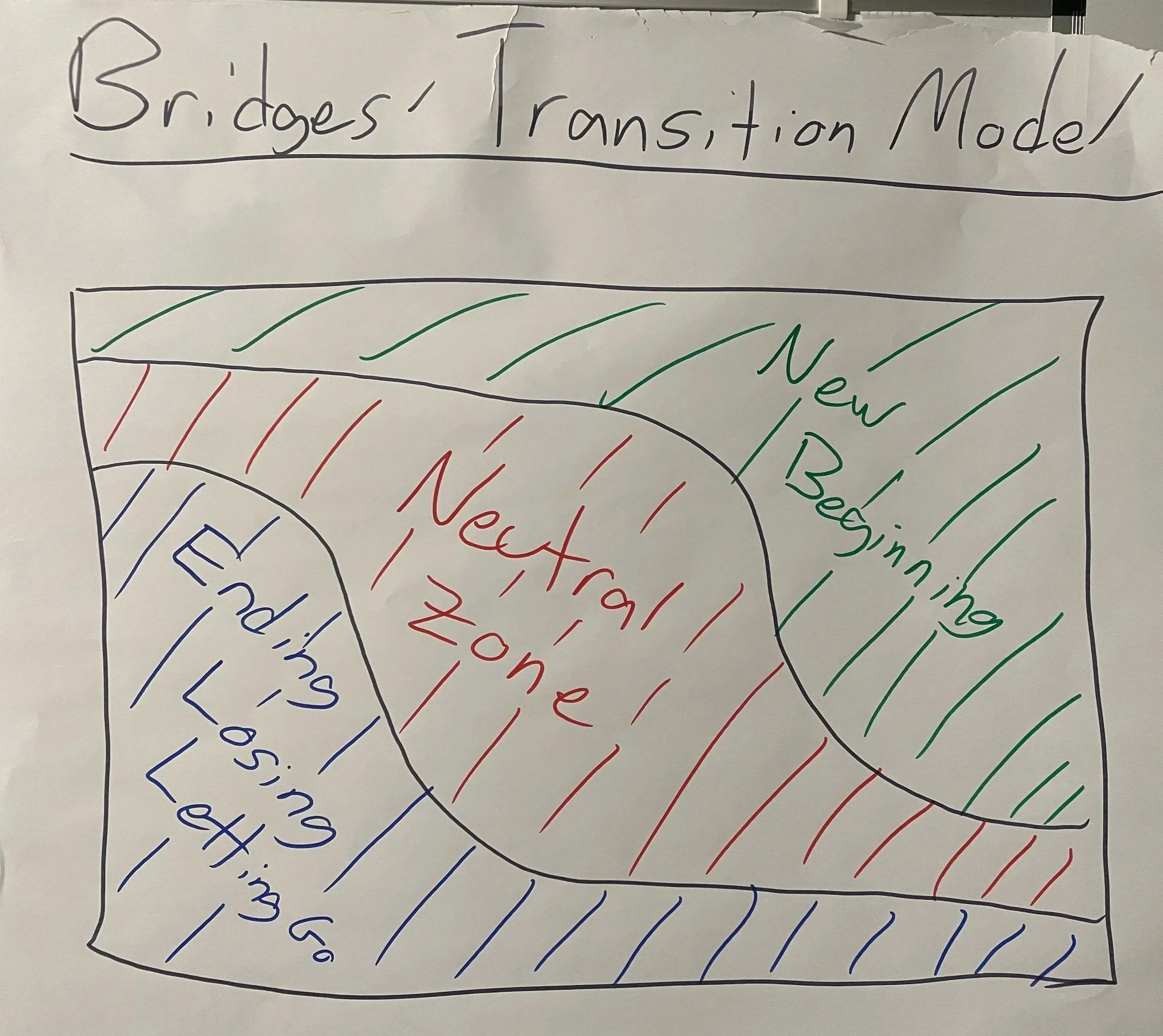
William Bridges, of William Bridges Associates, created this model to help people understand the work of transition. This model is used by the College for Congregational Development as one of its core models, and I have personally used it in many congregations and other contexts.
As you can see from the photo, the left side of the model is mostly taken up with Ending, Losing, and Letting Go. The right side of the model is all about the New Beginning, whatever that may be in any situation. The middle of the model is called the Neutral Zone.
As a diocese, we are in the Neutral Zone right now. The Neutral Zone allows the ending, losing, and letting go to be in process and moving toward completion, and loosens things up for whatever is to come. The Neutral Zone can be exciting, chaotic, creative, confusing, and challenging, all at once. In the Neutral Zone we learn to let go of habits that we had before the change, and we may create new ways of being or structures to support us as we move through the Neutral Zone. Those supports may or may not continue once we move to the New Beginning.
One illustration of this process is the traditional pattern of clergy transition in a congregation. In that pattern, a Rector announces their departure, beginning the Ending, Losing, Letting Go part of the transition. There are celebrations of the Rector’s ministry, final observances of feast days, visits to say good bye. Gradually the congregation moves into the Neutral Zone, as they take up the work of calling their next Rector. An Interim Rector may be called to lead the congregation as it does this work. Various committees are formed, such as a Profile Committee and/or a Search Committee, and the Vestry takes on new responsibilities in the absence of a Rector. Eventually the work of the search concludes and the vestry calls a new Rector. The final task of the Search Committee may be to facilitate the new Rector’s move to the area and to plan their Celebration of New Ministry. This brings the congregation into the New Beginning part of the transition, with all the excitement and potential that entails.
Notice that in the drawing, there are elements of Ending, Losing, Letting Go; Neutral Zone; and New Beginning present at every point in time. This reminds us to treat one another with grace and patience, as we all move through transitions at different paces. While some are celebrating a New Beginning, others may still be in the chaos of the Neutral Zone or mourning the Ending of what was.
I ask for your prayers for our amazing staff members as they move through this transition, and for your understanding when some of the edges in the Neutral Zone are a little rough. All of this transition is in service of the purpose of the diocesan staff: “The staff of the Episcopal Diocese of Iowa
exists to support the people of Iowa by creating spaces for connecting, listening, worshiping, and sharing resources in order to inspire, equip, and transform this diocese and the world for Christ.”
Together in Christ, we will move through this time of transition and into what God has in store for us in the future.
Yours in the abundant life of Christ,
+Betsey
The Rt. Rev. Betsey Monnot, Bishop of the Episcopal Diocese of Iowa