
The governance of the diocese is vested in the bishop and the governing councils and boards, including the Diocesan Convention, the Board of Directors, the Commission on Ministry, and the Standing Committee, each of which exercises specific duties and authority assigned to them by the constitution and canons of the diocese and of The Episcopal Church.
The Bishop serves as the ecclesiastical authority of the diocese, with the charge of convening the annual convention or special conventions, presiding at conventions, serving as president of the diocesan corporation and as an ex-officio member of the Commission on Ministry. When the diocese is without a bishop, whether due to a vacancy or disability, the role of ecclesiastical authority is assumed by the Standing Committee.
The Diocesan Convention, composed of lay delegates and canonically resident and licensed clergy, elects the ordinary and suffragan bishops of the diocese, and the officers of the convention and certain committees and commissions; sets the programs and policies of the diocese; adopts a budget for funding program and administration; sets assessments for funding the budget; and approves the admission of parishes or mission congregations to the diocese.


The Board of Directors
The Board of Directors heads the Corporation that acts as the legal body for the Diocese under the laws of the State of Iowa. The directors are trustees of all diocesan properties and monies. They also are responsible for the Iowa Diocesan Foundation Fund, which is a flexible and convenient investment fund for congregations as well as diocesan endowments and bequests. The directors necessarily are involved in the areas of property and securities. The directors also assist the Bishop in setting mission and ministry priorities, and assessing the work of its various commissions.
Members serve for a 3-year term.
-
The Rev. Kyle Carswell (St. Timothy's, West Des Moines), Metro Chapter Rep.
The Rev. Brian Gross (Christ Church, Cedar Rapids), Three Rivers Chapter Rep.
Paula Sanchini (Christ Church, Cedar Rapids), At Large
The Rev. Holly Scherff (St. John’s, Shenandoah), At Large
-
The Rev. Kevin Emge (Christ, Clinton), East Chapter Rep
Tiffany Farrell (St. Luke’s, Cedar Falls), North Cedar Valley Chapter Rep.
The Rev. Patricia Johnson (St. Thomas’, Sioux City), At Large
The Rev. Michael Kugler (Church of the Savior, Orange City), West Chapter Rep.
Tim Long (Trinity Cathedral, Davenport), At Large
-
Dale Schirmer (St. John’s Church, Mason City), At Large
-
President: The Rt. Rev. Betsey Monnot (Diocese of Iowa)
Chancellor: The Rev. Jean Davis (St. Paul’s Cathedral, Des Moines)
Treasurer: William “Bill” Smith, Jr. (St. Timothy’s Church, West Des Moines)
Assistant Secretary: Canon Julianne Allaway (Diocese of Iowa)
Standing Committee Representative: The Rev. Stephen Benitz (St. John’s, Mason City)
Commission on Ministry
The Commission on Ministry is charged with determining the current and future ministry needs of the diocese; recruiting aspirants for holy orders, and guiding and examining postulants and candidates for ordination; promoting continuing education for clergy and lay professionals; supporting and affirming ministry of lay people; and reporting annually to the Diocesan Convention. The Commission on Ministry assists the Bishop and the Standing Committee under the provisions of Title III of the Canons of the General Convention and the Canons of the Diocese of Iowa, and members are appointed by the bishop.
-
Vicky Matthiessen Krause (Christ Church, Burlington)
The Rev. Anne Williams (Anamosa)
The Rev. Alice Haugen (St. Paul’s, Durant)
Harvey Nicholson (St. Matthew’s by the Bridge, Iowa Falls)
The Rev. Jeanie Smith (St. Timothy’s, West Des Moines)
-
The Rev. Laurie Finn (ELCA Trinity Parish of Jackson County)
Patrick Hansen (St. Paul’s, Grinnell)
Robert Hubbard (Church of the Savior, Orange City)
The Rev. Kristine Leaman (St. Mark’s, Ft. Dodge)
Jenna Parker (St. Timothy’s, West Des Moines)
The Rev. Catherine Schroeder (Grace, Boone, & Good Shepherd, Webster City)
-
(continuing as reappointments)
Keila Eddy, Grace Church, Cedar Rapids
The Rev. John Greve, Grace Church, Cedar Rapids
The Rev. Kevin Powell, Trinity Church, Muscatine
Sarah Thompson, Grace Church, Cedar Rapids
-
The Rt. Rev. Betsey Monnot (Diocese of Iowa)
The Standing Committee
The Standing Committee acts as a council of advice to the Bishop. They approve or disapprove candidates for Holy Orders, the ordination of deacons and priests, all elections to the Episcopate in the General Church, and selling church property. They are responsible for the life of the Diocese in the absence or incapacity of the Bishop. (Article IX, Sec. 1-2)
Members serve for a 3-year term.
-
The Rev. Diana Wright (Trinity, Carroll; Trinity, Denison; St. Paul’s, Harlan)
Ed Gillott (St. John’s by the Campus, Ames)
-
The Rev. Stephen Benitz (Diocese of Iowa)
Ann McLaughlin (Good Shepherd, Webster City)
-
The Rev. Vincent Bete (St. Anne’s by the Fields, Ankeny)
Marcia Powell (Trinity Church, Muscatine)
Disciplinary Board
The Disciplinary Board shall be elected at diocesan convention for matters of Ecclesiastical Discipline, for a two-year term. (Canon 35, Sec. 2)
-
The Rev. Lizzie Gillman (St. Andrew’s, Des Moines)
The Rev. Ruth Ratliff (St. Luke’s, Cedar Falls)
Beth Stence (Trinity, Iowa City)
Laura Thilges (St. Mark’s, Fort Dodge)
-
Bill Early (St. Paul’s Church, Harlan)
The Rev. Kevin Edens (Trinity, Iowa City)
Ann Papouchis (St. John’s Church, Mason City)
The Rev. Catherine Schroeder (Grace Church, Boone, Church of the Good Shepherd, Webster City)
The Rev. Carolyn Tuttle (St. Alban’s, Spirit Lake and All Saints, Storm Lake)
Convocations
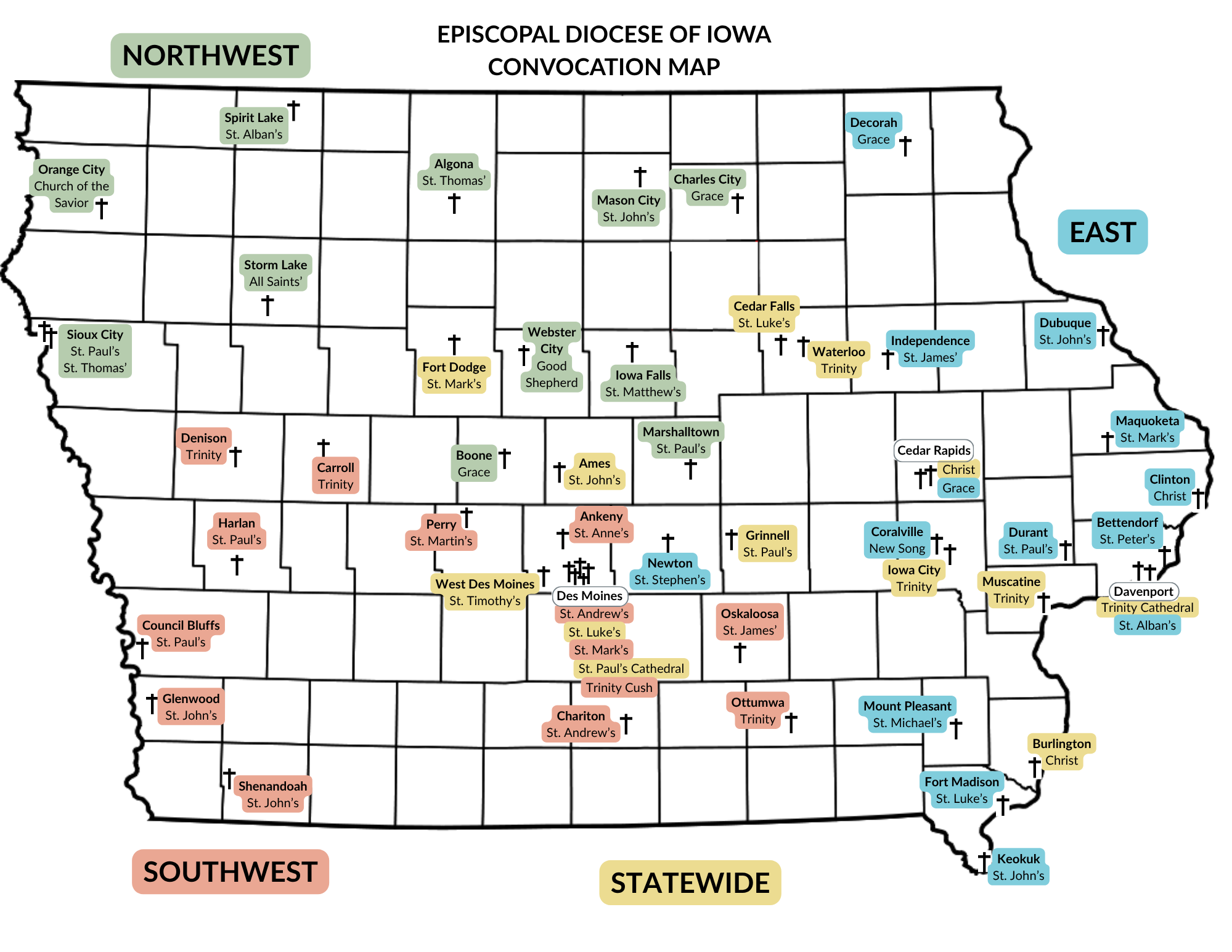
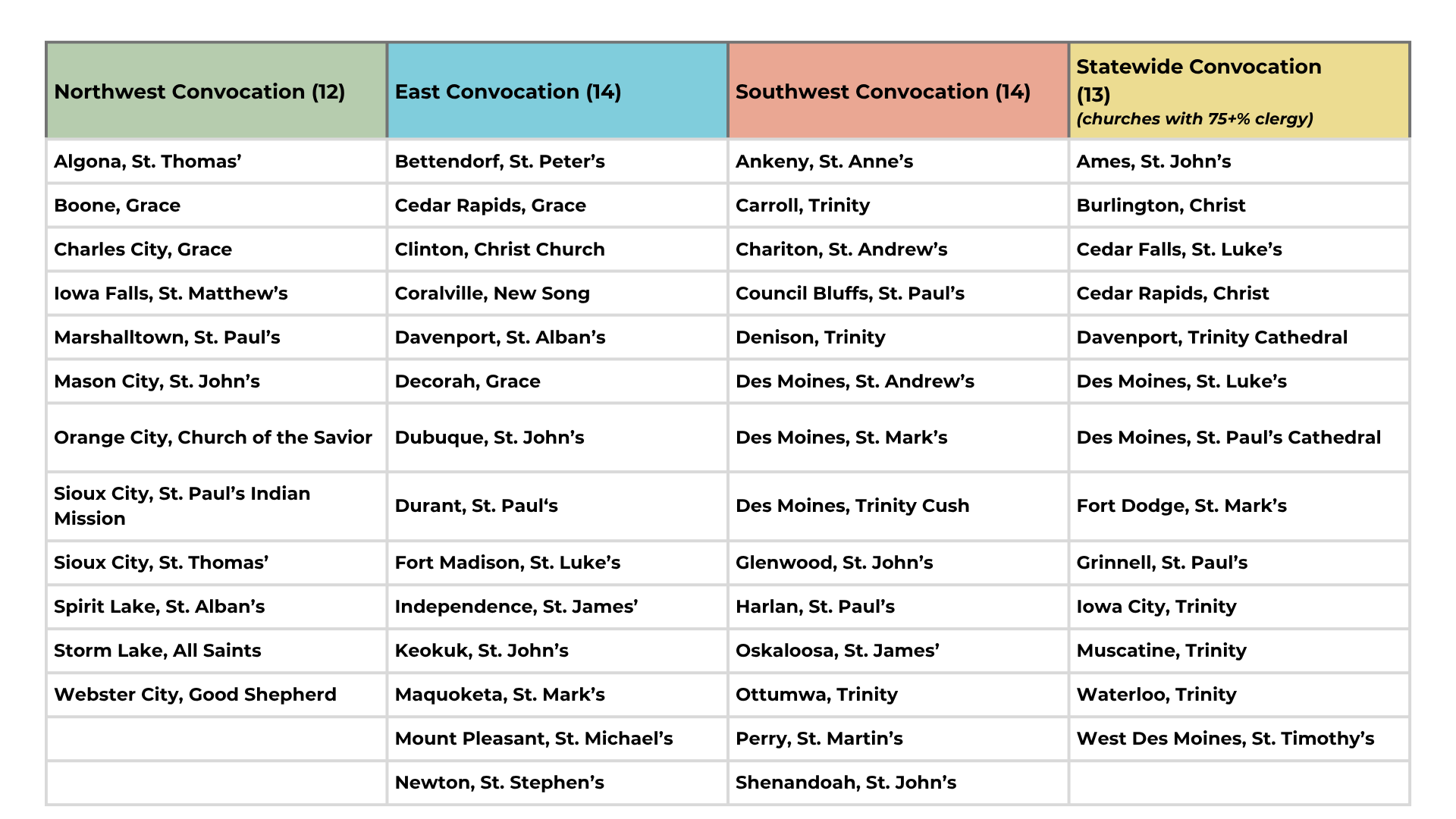
We are in the process of restructuring, transitioning from ten mission “chapters” to four “convocations.”
In Process:
The transition of Board membership:
each Convocation, like each Chapter, will select a Board Representative who will normally serve for a three-year term. Those terms will alternate between clergy and lay as they currently do.
This transition will take place over the next three years, as Chapter Representatives who are currently serving on the Board of Directors continue to serve and complete their terms. In 2025 and 2026, Convocations will not select Board Representatives as the number of Board members decreases. In 2027, Convocations will select Board Representatives at a Joint Convocation Meeting and those representatives will begin their terms at Convention in 2027. By Convention of 2027 the Board of Directors will have ten members: six at large (one clergy and one lay representative elected at Convention each year) and four Convocation Representatives (selected by Convocations and alternating between clergy and lay).
Completed:
Changed from ten to four, and determined which congregations are in each Convocation; formally took effect as of Diocesan Convention 2025
Canonical changes: at Diocesan Convention, 2025 we voted on canonical changes to clarify the details and the process of this change from ten Chapters to four Convocations. These changes include changes to both Canon 15 (Of Mission Chapters) and Canon 7 (Of the Episcopal Corporation).
For Reference: Mission Chapters
The diocese was previously arranged into mission chapters.
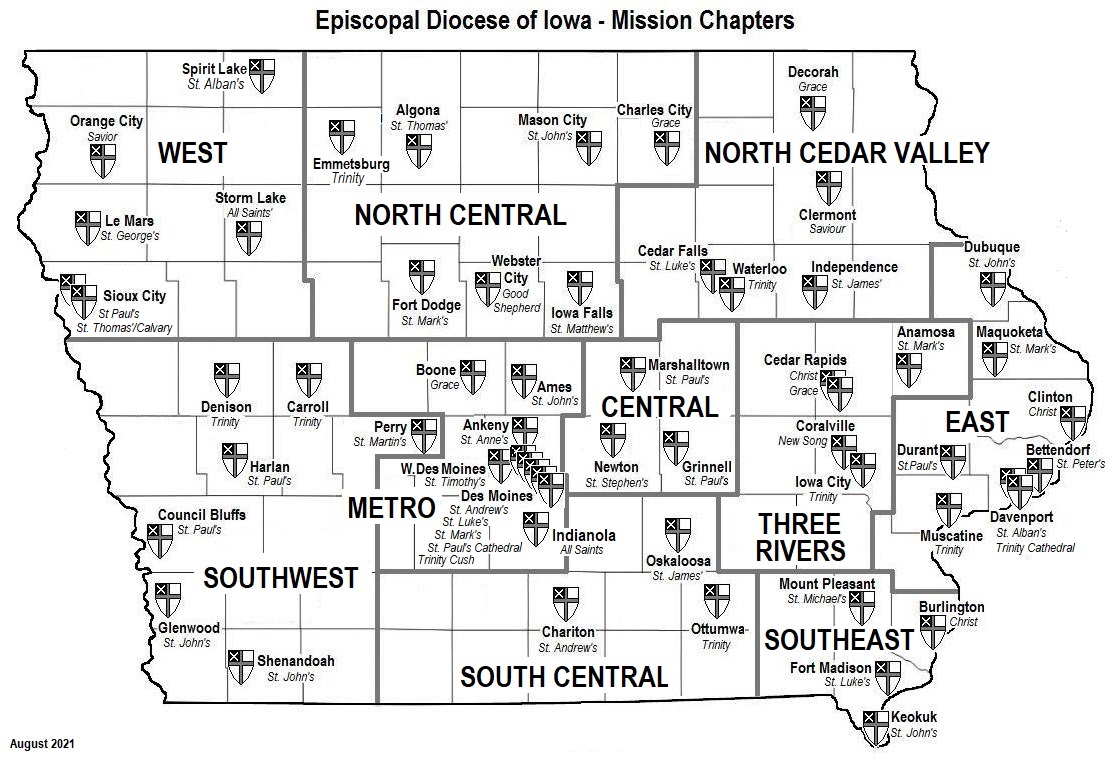
Map updated 2024
-
Grinnell, St. Paul’s
Marshalltown, St. Paul’s
Newton, St. Stephen’s
-
Bettendorf, St. Peter’s
Clinton, Christ
Davenport, St. Alban’s
Davenport, Trinity Cathedral
Dubuque, St. John’s
Durant, St. Paul’s
Maquoketa, St. Mark’s
Muscatine, Trinity
-
Ames, St. John’s by the Campus
Ankeny, St. Anne’s by the Fields
Boone, Grace
Des Moines, St. Andrew’s
Des Moines, St. Luke’s
Des Moines, St. Mark’s
Des Moines, St. Paul’s Cathedral
Des Moines, Trinity Cush
West Des Moines, St. Timothy’s
-
Cedar Falls, St. Luke’s
Decorah, Grace
Independence, St. James’
Waterloo, Trinity
-
Algona, St. Thomas’
Charles City, Grace
Fort Dodge, St. Mark’s
Iowa Falls, St. Matthew’s
Mason City, St. John’s
Webster City, Church of the Good Shepherd
-
Chariton, St. Andrew’s
Oskaloosa, St. James’
Ottumwa, Trinity
-
Burlington, Christ
Fort Madison, St. Luke’s
Keokuk, St. John’s
Mt. Pleasant, St. Michael’s
-
Trinity Cluster:
Carroll, Trinity
Denison, Trinity
Harlan, St. Paul’s
Council Bluffs, St. Paul’s
Glenwood, St. John’s
Perry, St. Martin’s
Shenandoah, St. John’s
-
Cedar Rapids, Christ
Cedar Rapids, Grace
Coralville, New Song
Iowa City, Trinity
-
Orange City, Savior
Sioux City, St. Paul’s Indian Mission
Sioux City, St. Thomas’
Spirit Lake, St. Alban’s
Storm Lake, All Saints’