2026 RMI Report to Convention
When we applied for the Thriving Congregations grant to fund the Regional Mission Initiative from the Lilly Foundation our goal was to find innovative ways to support and strengthen our lay and clergy leadership in small churches to address the challenges they are facing and to find new ways for churches to invest in the health and welfare of our towns in order to sustain vibrant community even as those communities lose population and resources. The Initiative kicked off in the fall of 2024 and we are now a little over 2 years into our 3 ½ year grant.
Where we are
In year 2, our 3 RMI Missioners expanded their work and have supported 33 different churches across the state in some different ways.
As we begin year 3 that number that number is slightly less, as we have also had RMI congregations who have discerned they do not have the internal capacity, sustainability resources, and in some cases the desire to participate.
What has the work looked like with those churches?
In the second full year of the Regional Mission Initiative, lay learning cohorts in three regions have continued to meet each month by Zoom.
Individual church teams meet about once a month for a coaching session with their missioner to explore new tools and practices to support them as they live further into a more primarily lay-led, clergy-supported model of church.
The missioners meet with the vestries at each of the churches to provide support and resources to build internal sustainability and vitality.
In addition, Missioners also check in regularly with clergy serving RMI churches and others in the region serving in any capacity. The Missioners serve as critical supply in places who are without regular clergy presence and for other churches in the region.
By the end of 2026, Missioners will have trained 50 lay and clergy members across the diocese to serve on Regional Discernment teams for those exploring calls to lay or ordained ministry. Several of those teams began meeting with aspirants in 2026 and some will be headed next to our Commission on Ministry!
Every RMI congregation takes an online Congregational Vitality Assessment each year to help them and our missioners identify priority areas for building sustainability and vitality and to give us some quantitative measures of the work we are doing in RMI.
As we evaluated the data from those Vitality Assessments in early 2026 and the changes from 2024/2025, we could already see several congregations – the ones that have been committed to trying the new practices from RMI that are seeing increased health and vitality especially in the areas of worship, lay Engagement & empowerment, outreach, and spiritual life (outside of worship). You can see that data reflected in this chart that shows the comparison in each of those areas in 2024 in the top bar of each category compared to 2025, or the bottom bar in each category. Red indicates low vitality, yellow moderate vitality, and green high vitality. In 2025 we saw many congregations move toward higher vitality in those areas.
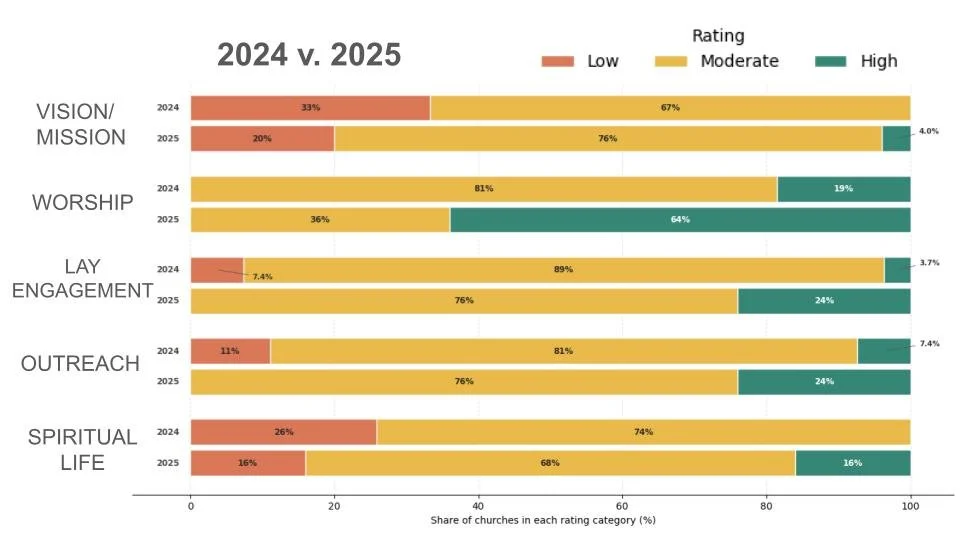
Those congregations are growing in vitality, deepening capacity, and developing an emerging sense of meaningful mission and purpose. They are choosing to try new things while deepening their connections to each other and their community.
So, what does that look like? Here are just a few examples:
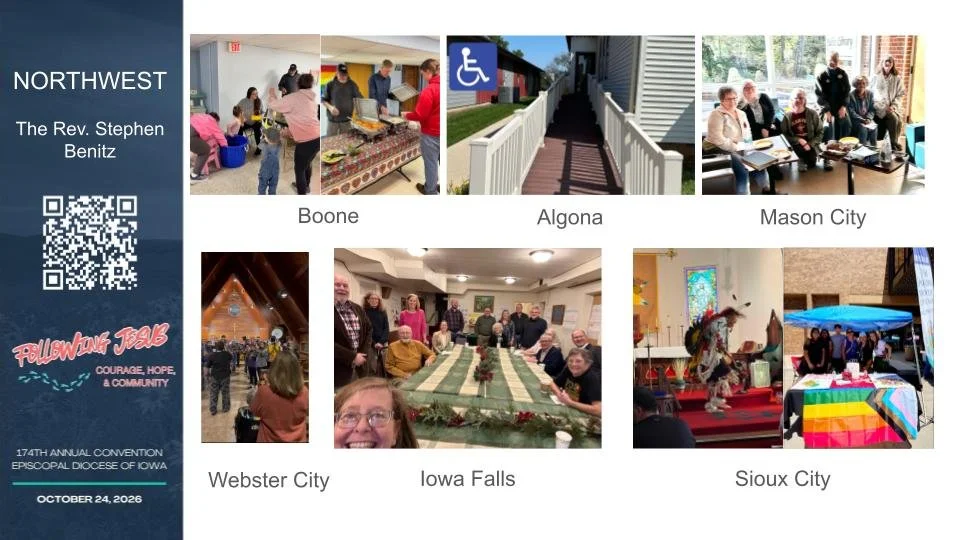
Northwest Region – The Rev. Stephen Benitz
Our Northwest region has its own Facebook page that anyone can join – you can search for them or just use the QR code on the slide. The region has compline on Facebook Mon-Friday at 8pm and hosted by Rev. Stephen and Rev. Catherine. The page is a place to share happenings at parishes throughout the region and anyone can join to be inspired and expand the prayer circle.
Grace Church in Boone spent time and effort beautifying its building and erected visible signs of inclusive welcome. In addition to welcoming new members, they now host a community-based feeding and gardening program Cultivating Community.
St. Thomas, Algona, remodeled their undercroft, added a first-floor accessible restroom, and improved building access and they are actively seeking community partners who can utilize the space.
St. John’s, Mason City now offers a lay led scripture exploration every Sunday prior to worship. They recently took it “on the road” by gathering at a local restaurant on a weekday evening and now they are showing up at the community library to discuss scripture and the movings of the Holy Spirit.
Church of the Good Shepherd, Webster City is opening up their space for community music events and beginning a partnership with the local ministerial association to start free laundry events in their local community.
St. Matthew’s by the Bridge is establishing new ecumenical partnerships and welcoming an ELCA pastor as part of the clergy team serving as long term supply there. They hosted a community dinner to share about what being Episcopalian means. They were inspired by St. Alban’s, Spirit Lake summer boat cruise and invited the community to join them for an evening worship on their own local riverboat.
St. Thomas and St. Paul’s in Sioux City were so inspired by our Episco-pals experiment in Boone that they volunteered to host folks from across the diocese for a weekend event of their own. They also hosted a booth at Sioux City Pride together for the first time.
Southwest Region – The Rev. Suzanne LeVesconte
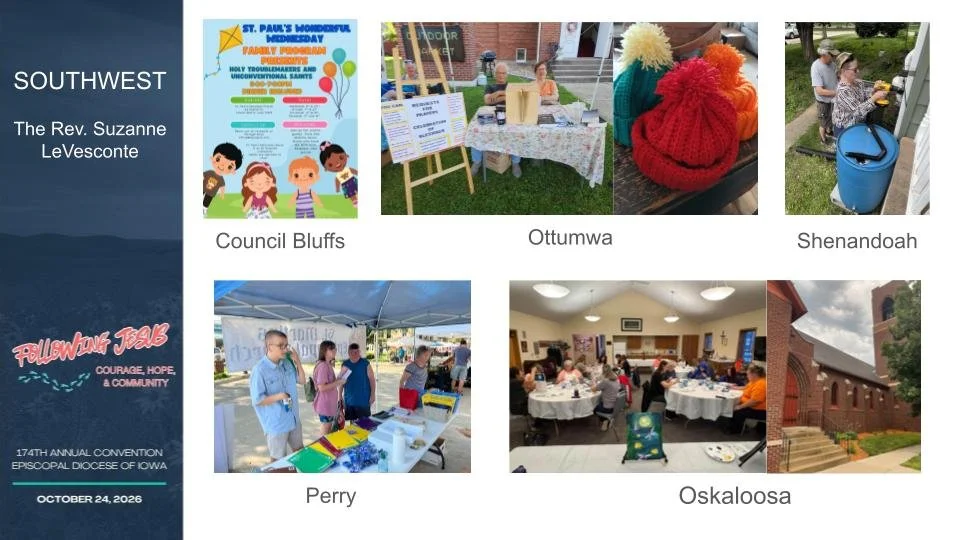
The Southwest parishes are also reaching and out and building connections with their communities and one another in small and large ways.
St. Paul’s in Council Bluffs is rebuilding the programs and connections to community lost during the pandemic, including resurrecting and restructuring their Wonderful Wednesday Program which will serve both children of parishioners and children in the neighborhood.
In Ottumwa, Trinity Episcopal and St. Paul’s Lutheran continue their successful joint experiment begun last year of a Prayer Table at St. Paul’s Summer Market held twice a month from late spring to early fall. This collaboration has expanded into a shared Bible Study and a shared Crochet/Knitting Group. Completed scarves and hats will be placed outside the library this winter for those in the community in need of some extra warmth. And the Bible Study Group is considering taking their Bible Study to a café or restaurant at least once a month, wearing parish identifying tee-shirts.
St. John’s Shenandoah continues to bear the fruits of their embrace of RMI through continued worship experiments, including use of Dwelling on the Word during Morning Prayer services, and a substantial increase in financial giving. They started a neighborhood peace garden and hosted a rain barrel class for the community. Rev. Suzanne has facilitated conversations between St. John’s and 2 Lutheran Parishes and is entering into shared ministry covenant with one of them this fall, with the Rev. Holly Scherff serving both churches and the hope of more and more collaboration down the line.
St. Martin’s in Perry made their presence known at the Perry Farmer’s market and handed out school supplies for children for the second year. They also started a Taco Tuesday with the neighborhood.
St. James Oskaloosa did excellent work around the Gather, Transform, Send Model. Concentrating on the Inviting portion of the Gathering step, they chose three ideas to take action on: Repairing the Bell to begin once again sharing bell music with the neighborhood, installing video equipment to share worship services with the wider community, and hiring an intern to help the parish connect to community needs. They recently hosted community members at a paint class in their parish hall that was a great success.
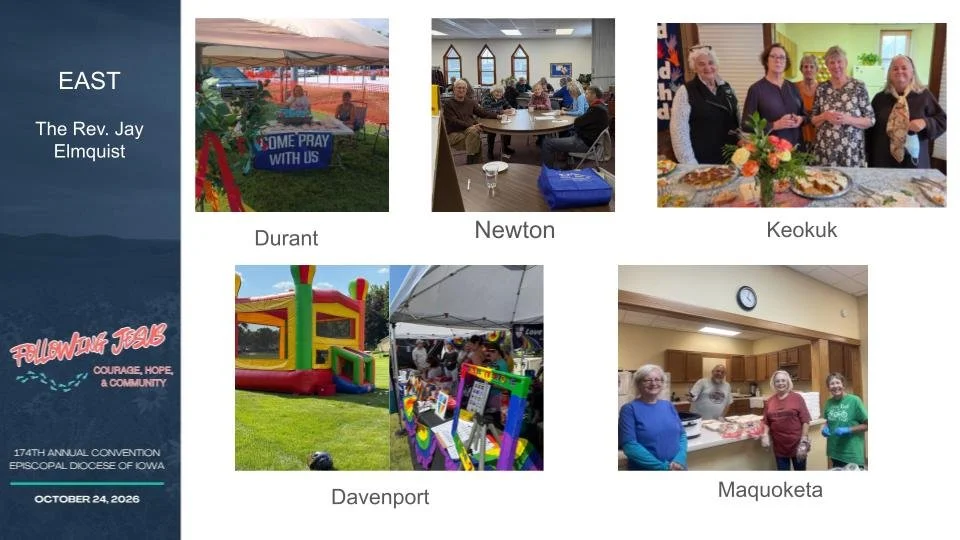
Eastern Region – The Rev. Jay Elmquist
In the Eastern Region at St. Paul’s, Durant, they had a prayer booth at the local festival last summer and found that folks avoided contact with that tent. That surprised them. So, they looked at some of the reasons and revamped their presence at the next community event to be less “churchy” and to include a free meal for anyone who wanted it. It was a booming success. They were still able to pray with and invite folks to be a part of their ministry without the church identity being such a big thing.
The people of St. Stephen’s, Newton worked on Asset Mapping for their congregation. They started at their Annual Meeting and worked a couple more times to refine the list of assets that they have available through the talents and gifts of their people, their physical plant, and the financial position of the church. What they found is that they are much richer than they thought, especially when they counted all of the personal gifts that each member brings to the table. One member said, “This was such a positive experience. We found such richness in our people. I would suggest this activity for any church.”
At St. Alban’s, Davenport they have been working on the welcome that their signage and property provides. They have repainted and repaired signs as well as looking at ways to make folks feel like their property, which is extensive, could be more accessible to their neighbors, and installing a path from the sidewalk to the garden. Their recent parish picnic included a bouncy house and they they had a table of food out by the street to welcome folks who came by. Dog treats and water as well. And they worked together with the Quad City Episcopal churches to have a booth at PRIDE.
At St. Mark’s, Maquoketa, the vestry worked with Father Jay to hold a Visioning and Missioning retreat to help articulate their mission in a way that reflects the current needs of their community and their church. At church potluck meetings the vestry inventoried the values of their place and mapped their assets. Out of these meetings they were able to craft new mission and vision statements to help them form the ministry they hope to have in the future.
The vestry at St. John’s, Keokuk has been working with Father Jay to identify the ways that they might work cooperatively with other churches in the southwestern part of the diocese and with one church just across the river in the Diocese of Chicago to share ministry and possibly clergy in the future.
Ahead in Year 3
I’m thrilled to say that our Regional Mission Initiative is one of a small group of grant recipients that have been invited to apply for another grant to help us sustain or grow our initiative alongside a matching investment from us.
We are exploring what expanding our work could look like – to support more churches in new ways, given all we have learned and heard in our diocesan listening process and through the last 2 years of RMI and we plan to apply in 2027.
Cohorts will be asked to expand their partnerships with other churches, non-profits, and organizations to address quality of life and belonging issues in their communities.
Missioners will work with vestries on a plan for ongoing, sustainable ministry development and clergy support.
More regional trainings for lay people to lead ongoing formation, lay ministry training, and vocational discernment opportunities.
We are incredibly grateful for the bold and creative, faithful and fruitful work being done by all our RMI churches, teams, and missioners!